Home Blog Page 5

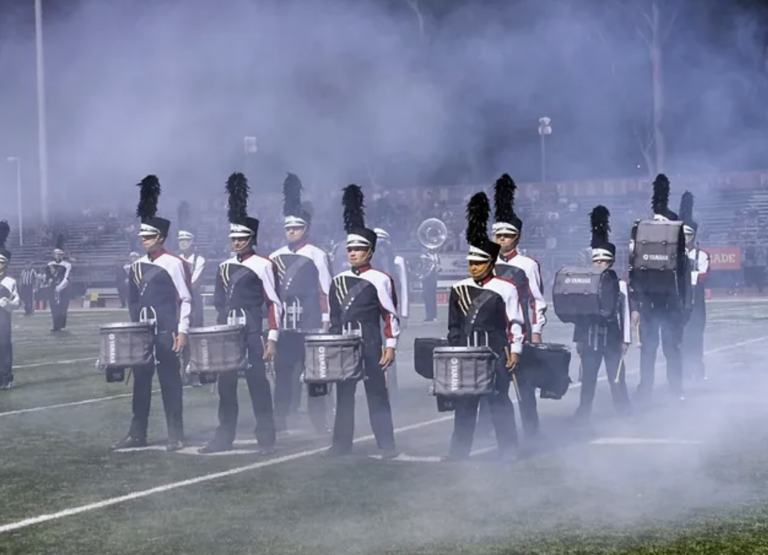
The MVHS Marching Band is in High Demand

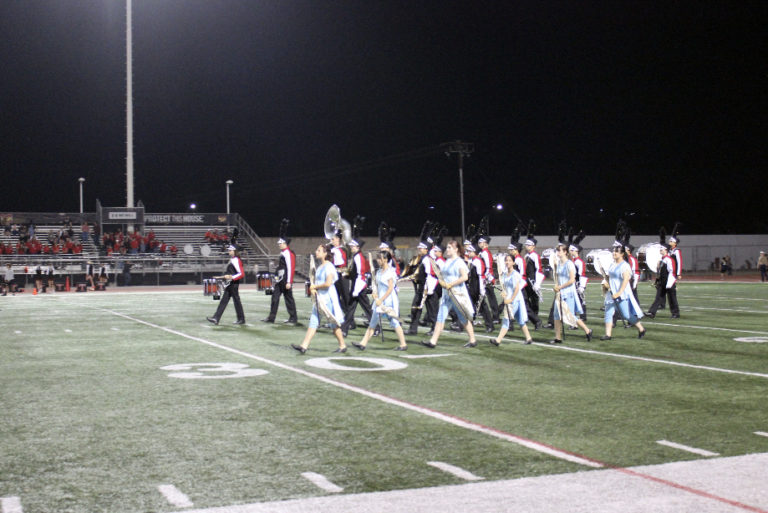
     Following a series of competitions that took place in the fall season, our very own Mission Viejo High School marching band and color guard competed in the 1A/2A/3A Western Band Association Class & Grand Championships on November 19th. They won third place in the competition, as well as winning high percussion and high auxiliary awards.

      In this season’s other competitions, the band has won three high percussion awards, two high auxiliary awards, two first place in visual performance awards, two first place in the 2A division awards, and one third place in the 2A division award, according to an interview with the band director.

     Despite being small for their division, the four-time WBA Grand Champions have managed to carve quite a name for themselves. Due to a couple drop-outs from the team, the MVHS marching band has been competing with 46 members: four less than the minimum number of members in the division’s competing teams.

     According to band director, Mrs. Lee, one of the season’s challenges has been competing in a larger division. “It’s sort of like a David versus Goliath anytime we go out to compete,” she explains. “We practice so much. There’s so many hours to what we do. The standards are just really high, the demand is really high, and we work at this all semester long for a seven or eight-minute show.”

      On top of dealing with a smaller number of members and the many hours of practice, the marching band also has had to learn some very difficult music. In the interview I conducted with her, Mrs. Lee revealed how the goals of the MVHS marching band are more long-term than short-term.

     She says, “I’ve given them musical content and visual content that’s probably just a little too difficult for them. It’s very challenging… Once they get to being in division 4 or 5A rather than 2A, they’re going to face bands that are playing much harder music and we need to start cultivating that demand now. In their division, they are playing music that’s much more difficult than other groups around them. So, it’s been pretty great watching them rise to that occasion.”

     Along with improving their skills for the future, the band is focusing on cultivating better teamwork, work ethic, and musical excellence.

     Lee also maintains that “the characteristics of a successful band come with having high standards and a perception of excellence that’s not demeaning or toxic, but rather uplifting. So, something that we’re working on is finding excellence outside of being overly self-detrimental and instead chasing positive goals and positive things that we’re hoping to integrate into our own playing and habits.”

     Beyond just music, the marching band can teach some real-life skills such as communication, art, cleaning, and other activities involving both teamwork and common sense.

     Overall, the MVHS marching band has worked incredibly hard for their shows, and it is shown in the awards they have received despite being small for their division.

     To show your support for our resilient marching band and color guard, go to their shows! Lee says, “It would be so great to see some support, especially when we have shows… When we’re local, it would be so, so good if we could get some student section folks in the crowd. Especially since we’re practicing for five days a week for several hours at a time. We would love to see everybody there.”

All a-boat the ILWU

      With the strikes from SAG-AFTRA, the WGA, and the UAW, 2023 was brimming with talk of unions. So, for a change of pace, here’s the story of an acronym that you might not have seen in the headlines this year: the ILWU.

     The International Longshore and Warehouse Union largely represents dock workers along the West Coast of North America. The ILWU website explains, “We are dedicated to the welfare of our membership and to a better life for the people in the communities in which we live.”

     In case you weren’t familiar, longshoring is the work of loading and unloading ships. According to the University of Washington’s Waterfront Workers History Project, it is “a highly skilled line of work that involves careful balancing and weight management within ship holds.” It is incredibly taxing, as well as very dangerous.

     To learn more about longshoring and the union behind it, I turned to someone who knows longshoring like the back of his hand: my grandfather. Gilbert Valles, known as “Guillotine Gil” on the docks, was a longshoreman and later a longshore foreman for almost forty years.

     Growing up in San Pedro and Wilmington, California, my papa would see the giant maritime vessels come in. “It was very fascinating to me. Plus, my dad worked down on the docks. So, I would always have access to see those ships and they just fascinated me,” he explains.

     He started longshoring after he returned home from being drafted into the army in 1962. His work began at 26 years old, with the unloading of bananas on the stem. My papa talked about how the work he did was very difficult, but because he had “a lot of old-time guys that showed me a lot of tricks to move a lot of heavy equipment,” he felt lucky. “A lot of it is just the knowing how to do it. You don’t have to be like Superman,” he adds.

     For the longshoremen, each day of work could look completely different. Before my papa witnessed the shift from labor done by hand to containerization, he got to learn all sorts of interesting skills, including driving cranes, working in the hull, driving forklifts, and much more.

     However, he also stresses the importance of “learning how to get along with your fellow workers.” He explained this significance by describing the process of getting job assignments: “You don’t work with the same people every day. One day, you might work with guys for three or four or five days, if the job lasts that long. When it’s over with, you had to go back to the Dispatch Hall and you get another job. Well, you might not see those same guys again for God knows how long.”

     Despite this constant change, my papa’ favorite part of being a longshoreman was the camaraderie that the workers all shared. He explains, “We handled different cargoes from all over the world, and it was exciting. It was fun. A lot of it was really hard work at times, and sometimes it wasn’t so bad… It was enjoyable.”

     This whole idea of their camaraderie is quite evident in the story behind my papa’s longshoring nickname: “Guillotine Gil.” He shares, “That nickname was given to me by a friend of mine. When I walked into a lunchroom one day … there was a bunch of new longshoremen in there having lunch. So, this friend of mine jumped up as I walked into the dining room and said, ‘Hey, all you brand-new longshoreman, you better watch out. Because here comes Guillotine Gil and you do one thing wrong and he’ll chop your head off!’ … It went around the waterfront like wildfire!”

      Throughout his longshoring career, my papa had the support of the ILWU. He explains that it’s such a strong union due to its grasp over the ships in all the ports along the West coast of North America. “That’s a powerful chip for the union’s side,” he explains.

     By negotiating against the ship owners, the ILWU has helped to provide many benefits to the dockworkers. An example of this is the ILWU strike in 1971. It had to do with the threat to job security because of an increase in ship containerization. The union bargained to train the longshoremen on how to maintain the new equipment, and even though it was a rough time for all, the ILWU was ultimately successful in gaining this jurisdiction.

      My papa worked so hard, seven days a week, doing very difficult (and dangerous) work. Even so, he says, “(The ILWU) gave me and my wife, and my entire family, a great living and a great lifestyle.”

     Even today, my papa is still involved with the ILWU as he attends the monthly Pensioners’ Meetings, which provides updates on “what’s happening on the entire coast of the West Coast Long Shore,” as well as a “great big prime rib cookout” that’s held every October. It’s a big event, with live music, a full bar, and a longshoreman who cooks all the prime ribs on portable barbeques. “Everything is a very nice turnout and it’s good unionism (when) we come together like that,” he says.

     When it comes to unions in general, my papa believes they’re important to have, especially in terms of organization. “You have the people behind you to stick together and you challenge the employer … instead of them taking all the money for themselves. You know, it’s the workers that make the owners rich. So they should share some of that big profit with their workers. And that’s what unions try to do.”

     Despite the work being, at times, a challenge, my papa says, “I would not change or trade any part of my job for anything else after I’ve done it and I lived it… It’s probably one of the greatest labor jobs in the world, with high pay and the greatest benefits… To me, it’s the greatest job on the planet as far as working goes.”

     Overall, I had a really great time interviewing my papa about longshoring and the ILWU. And who knows, maybe even the next time you eat a banana, you’ll think about the longshoremen and their work.

     Finally, my papa would like everyone to know one of his favorite pieces of advice: “There’s nobody in this world that’s going to give you something for nothing. Always remember that.”

Loki is a low-key hit — and only one part of the inter-connected future of Marvel

     “I am Loki, of Asgard, and I am burdened with glorious purpose.”

     In the case of the hit Disney+ Marvel series, Loki, “glorious purpose” refers to continuing the next installment of the very intricately-designed universe, with extremely devoted and critical fans, which is none other than the Marvel Cinematic Universe: a multi-billion dollar media franchise of movies, television shows, and more, which are based upon the classic Marvel superhero comics.

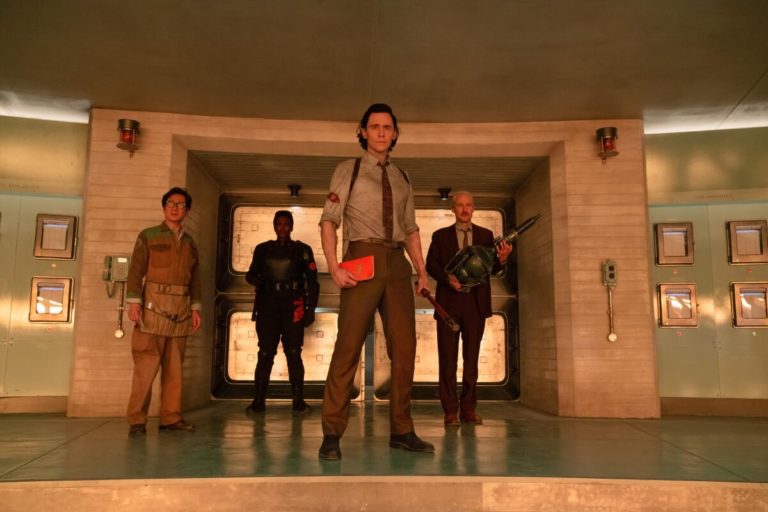
     Following the release of the first two MCU television series, Loki was released onto the increasingly popular streaming platform, Disney+ on June 9th, 2021. Featuring Tom Hiddleston returning as beloved supervillain turned anti-hero turned hero, Loki, as well as with a supporting cast of Sophia Di Martino, Owen Wilson, Gugu Mbatha-Raw, and Wunmi Mosaku, Loki became yet another Marvel project to feature the idea of the multiverse.

     After getting into trouble with the Time Variance Authority (TVA), Loki finds himself in a bit of a pickle. He ends up trying to catch a version of himself from a different universe, and along the way, discovers the disorder behind the TVA.

      The show is connected to many other Marvel projects, including Avengers: Endgame, Iron Man, Thor: The Dark World, Thor: Ragnarok, Thor: Love and Thunder, and Ant-Man and The Wasp: Quantumania.

     The first season received a pretty high IMDb score of 8.6, a great Rotten Tomatoes Tomatometer score of 92%, and a Rotten Tomatoes Audience rating of 90%.

      I found the first season to be quite enjoyable, albeit a bit difficult to follow at times. As you might expect, a show dealing with all of time across every single universe in the multiverse is, needless to say, complex.

     However, I enjoyed how they incorporated the stories into the plot. The multiverse parts of the story did feel a little forced (probably because they were) but they managed to create a very interesting story with lots of well-developed characters and fan-appealing scenes.

     The end of the first season also (finally) introduced Kang the Conqueror into the MCU. Presented as “He Who Remains” in the season finale, a variant version of the character, Kang himself goes on to be one of the main players in Ant-Man and The Wasp: Quantumania.

     Kang the Conqueror is a beloved (and extremely powerful) supervillain in the Marvel comics, and the first episode of Loki’s second season seemed to not-so-subtly hint at his extent of power.

     The first episode of Loki, season two, was released on October 5th of this year. There are currently three episodes available to stream on Disney+, with more to come in the coming weeks.

     The season premiere, entitled “Ouroboros” after the new character played by Ke Huy Quan, follows Loki as he is being pulled in between two different timelines. The present timeline, where he has his friends, and the future — a disturbing timeline in which Kang Variant, “He Who Remains,” is the leader of the TVA. The episode received an IMDb score of 8.3/10.

     The first episode was very entertaining, and I cannot wait to finish the rest of the series when it comes out. It is clear that this story is going to be pivotal for the future of some other Marvel projects, yet it still manages to capture the comedically quirky vibe of the first season.

     So far, the whole second season itself has a Rotten Tomatoes Tomatometer rating of 85%, a Rotten Tomatoes audience rating of 91%, and an overall IMDb score of 8.1.

     Loki is only one step in the future of Marvel projects. In the next few years, fans can expect several highly-anticipated imaginations of well-loved Marvel Comics stories, including The Marvels (November 10), What If…? season 2 (Late 2023), X-Men ‘97 (Early 2024), Deadpool 3 (May 3, 2024), Captain America: Brave New World (July 26, 2024), Ironheart (2024), Daredevil: Born Again (2024), and something I am extremely excited for, Blade (February 14, 2025)!

     With years and years of planned content for the future, Loki is only one part. There are so, so many comics that have yet to be taken to the silver screen, and fans like me can appreciate the spectacle of a comic brought to life.

With (pink) ribbons and lace, and many a brave face, these fighters are powering through — this is a fight that you can join, too!

     October is the month of Halloween — the month of pumpkins, skeletons, spiders, and witches’ hats. Everywhere you turn, nature is celebrating the changing seasons with vibrant colors. And so are the stores you shop at, the houses on your street, and the decorations in your very bedroom.

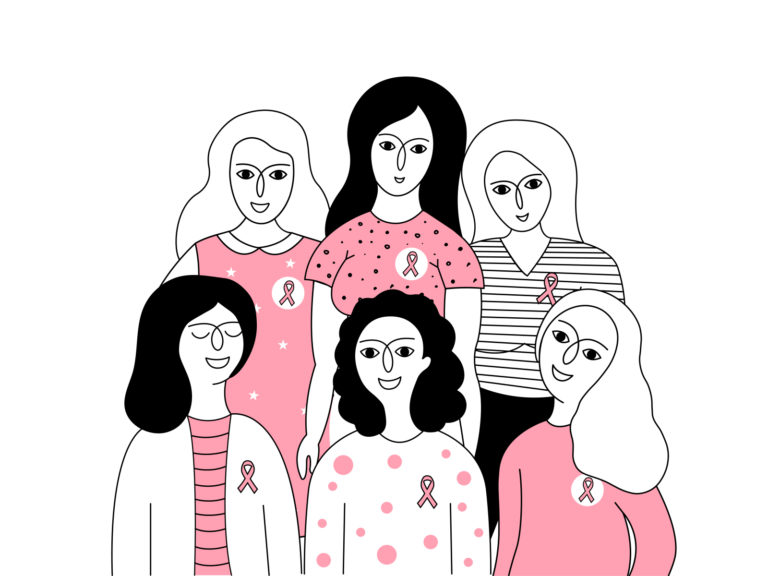
     Yet among this sea of oranges, reds, greens, purples, and blacks is arguably, the most vibrant of all: pink! And I’m not talking about the swarms donning Barbie-esque attire… I’m talking about the pink ribbon.

     The very pink ribbon that has become the universal symbol of breast cancer. The very pink ribbon that, according to the National Breast Cancer Foundation, was created as a matter of protest against the low national budget for cancer prevention. Today, the ribbon is recognized as a powerful symbol representing breast cancer awareness.

     The pink ribbon, which also comes in many variations to represent different types of breast cancer, is encouraged to be worn during October — Breast Cancer Awareness Month.

     BreastCancer.org explains that the month originated from the American Cancer Association’s week-long awareness campaign, which developed into the month that is recognized today. Now, walks, runs, and other events take place throughout the month, with most participants adorned in pink attire.

     Their goal is to raise awareness about the disease, gain funds to promote research, and provide support.

     In case you’re not familiar, breast cancer is a disease that occurs when cancerous cells form in the breast tissues. There are many different types and stages of breast cancer, and, despite popular belief, it can affect anybody. Many factors can influence the risk of developing breast cancer, including age, ethnicity, and sex.

     According to the National Breast Cancer Foundation, 1 in 8 women in the U.S. will receive a breast cancer diagnosis at some point in their lives. The source also mentions, “In 2023, an estimated 297,790 women and 2,800 men will be diagnosed with invasive breast cancer.”

     And, horribly, an estimated 43,700 women in the United States will die from breast cancer in 2023. This is why it is so crucial to be conscious of breast cancer and methods of detection to prevent tragic results from the disease.

     The Centers for Disease Control and Prevention explains that, though there is no way to eradicate the risk of breast cancer from your life, there are a few actions you can take to live a healthier lifestyle. According to the CDC, being active, keeping a healthy weight, and avoiding excessive alcohol use can all lower the risks.

     However, breast cancer screening can help to detect breast cancer in its earliest stages, and therefore prevent the disease from becoming worse with time. The National Breast Cancer Foundation states that women who do not receive regular screenings have a death rate from breast cancer that is 26% higher than that of women who do.

     The American Cancer Society explains that, “Breast cancer typically has no symptoms when the tumor is small and most easily treated, which is why breast cancer screening is important for early detection.” Some options for screening can include mammograms, MRIs, clinical breast exams, and self-breast exams.

     Some ways that you can show support during Breast Cancer Awareness Month include donating to organizations such as the American Cancer Society, volunteering with organizations that advocate for cancer issues, educating yourself and your loved ones, and purchasing and wearing pink articles of clothing whose funds directly support the health campaign.

     Breast Cancer Awareness Month or not, it is of the utmost importance to be aware of this information. The U.S. Office of Women’s Health states that cancer is the second leading cause of death for women in 2023, following heart disease.

     By being equipped with information, you can help prevent not only yourself from breast-cancer-related death, but your loved ones as well.

     As the National Breast Cancer Foundation conveys, “Chances are, you know at least one person who has been personally affected by breast cancer.”

     As somebody who has lost a truly amazing woman to breast cancer, my grandma, I cannot stress enough how important this topic is. I know how important it is to stay on top of monthly self-breast exams and will never miss a regular professional screening once I am of age. I implore you all, whoever you are, to do the same.

     When it comes to breast cancer awareness, and, really, to life in general — it’s one thing to be aware, but it’s essential to be active.

Why are you insecure?

     Growing up, I always thought my teen years were the time of insecurities and blossoming maturity. I believed that 15 or 16 years of age was when girls would start to leave their phase of youth and start to express themselves in an older way. 

     But by age 11, girls in my classes started already trading in their stuffed animals and barbies for eyeshadow palettes, hair straighteners, and crop tops. Was it because of some unpredicted shift in youth culture, or was it because of their early introduction to the internet, seeing these older influencers gain popularity for their maturity and wishing to mimic the behavior to also gain popularity?

     Ever since social media was first introduced, countless accounts of body dysmorphia, especially amongst teens, have emerged and grown in numbers as their usage amongst the general population increased.  

     In Big Think’s video “Social Media addiction – how it changes your brain,” writer and businessman Luke Burgis notes the difference between external mediators of desire (the rich and famous) and internal mediators of desire (people whom we see online and close in person who we wish to become). To idolize having a celebrity lifestyle is something that is less detrimental since it is less attainable. To idolize an online presence, however, can be catastrophic to a person’s wellbeing, as getting followers is much easier than becoming a millionaire overnight. 

     Yet, it’s not just the obsession of becoming internet-famous that can cause weakening mental health; body image and trends presented on social media have been leading cases in declining self-esteem for the past few years. 

     Since the start of social media, advancements in technology of filters and apps like facetune have been used by influencers and celebrities to alter their body shapes to fit unrealistic beauty standards. In a study on photoshop used with images on social media, it was found that 71% of pictures posted to these sites are edited before being posted. What’s even worse is that many users who see these pictures are unbeknownst to the modifying of them, making it very easy to become wrapped into the self-doubt of your physical appearance in comparison. 

     These alterations only bring fuel to the fire that is body dysmorphia and worsening mental health. In unison with the rise of social media, accounts of eating disorders have increased from 3.4% in 2000 to 7.8% of people in 2018. Depression rates amongst adolescents have in addition risen from 8.1% to 15.8% between the years 2009 and 2019 as seen in the National Survey on Drug Use and Health.

     Cyberbullying also plays into this persistent issue. Body shaming is one of the most common forms of bullying online, the fact that it can be done in a (anonymous?) manner without much repercussion making it chosen and constant throughout all platforms. This form of harassment has become a larger issue in the past few years amongst apps like TikTok and Instagram: two forms of social media whose users are largely Gen Z. 

     Despite the clear trend that social media’s increasing effect on youth is detrimental, this issue is not one that can fully be resolved. As a society, the world’s accessibility to the internet alone has made it so incredibly easy for people to become addicted. In just five years, the amount of Tik Tok users universally have spiked from 271 million to 1 billion, in addition the number of Instagram Users increasing from 1 billion to 1.35 billion. On average, users individually spend over 130 minutes a day on social media, while Gen Z spends almost four hours every single day.

     A decade ago the majority of phone and tablet users were adults and teens; currently, kids are receiving phones as early as elementary school, and the mere idea of a tablet conjures the image of a toddler playing Cocomelon on their dirty, sticky ipad.

     Most people’s solutions would be to just distance youth from the internet, to limit their access to these entry ways into the online world. Yet, taking this course of action in turn damages the placement of a teen in their society, as so much of youth culture is centered around jokes and topics online.

      In truth, being a teen in this day and age is so much worse than time before. You not only compare yourself to people who you know in your life, but also every single person online who you see on social media. There are constantly fluctuating and unattainable beauty standards that you’re faced with, that you feel if you don’t live up to them, you might be mocked for it.

  Only in the past few years social media has been prominent, this form of global connection quickly turned into a breeding ground of hate and self-doubt. It makes you wonder: will it ever get better?

Halloween and the Real Reason it’s Celebrated

0

     Halloween is a national holiday celebrated all over the world, though not officially made as a federal holiday. Have you ever wondered what the true origin of this holiday is?

     Halloween first originated in ancient Britain and Ireland by the Celtic people. On this night, people would light bonfires and candles while wearing costumes to drive away the ghosts who were thought to be ravaging their crops.

     Some of the costumes worn included saints and biblical figures, as this holiday was first created by the church. Celts believed that their ancestors’ spirits would visit them on this day, and would lay out offerings such as food, drinks, and jewelry for them.

     Originally, Halloween was celebrated on the first of November to honor saints. The day before was this holiday’s eve. This turned into the holiday we all know of today, Halloween. During the middle ages, Halloween was a time for the people to gather together, have feasts, play games, and even throw parades. Trick or treating was also celebrated during this time. 

     All of the Halloween traditions that we celebrate today have been around since the beginning of this day. Carving pumpkins and turning them into jack-o-lanterns used to be made up from carving turnips, potatoes, or beets and making jack-o-lanterns out of those. The reason for carving turnips and not carving pumpkins like we do today is because pumpkins were not indigenous to Ireland. As years went on North America started to take on this holliday, where pumpkins were native to their land. 

     Trick or treating during the origins of Halloween was a little different than today as well. Small groups of people, mostly the poor in costumes, went from house to house and performed little tricks in exchange for food and drinks.

     The theme of costumes worn back then consisted of ghosts, witches, devils, and skeletons. Haunted houses were also not around until the Great Depression where parents came up with ways to distract the children whose Halloween pranks turned into vandalism and property damage. 

     After many years Halloween has changed. Nowadays people don’t look at this holliday as an ancient ritual. Halloween is a day full of activities and fun still including those traditions of long before. Carving pumpkins, trick or treating, costumes, eating treats, and watching scary movies are now the main attractions. There are some people who don’t celebrate this holiday due to religious reasons. Jehovah’s Witnesses, some Jewish, and Muslims are some of the few. 

     No matter what you do, everyone loves to celebrate this day in different ways, children love to go trick or treating from door to door, while others love to dress up and go to Halloween parties. Some just like to stay at home with a bowl of candy and enjoy  scary movies.

A Look into the Marching Band Season

0

Winter, summer, spring, and back to fall as football season begins, so does band season. And with band season comes band camp, competitions, halftime shows, and a team that slowly becomes some of your closest friends.

     Band is a lot more than playing music. There are fun games to play during band camp, a variation of secret Santa for competition season known as “Secret Pals” and memories to last a lifetime. 

     Of course, playing music is one of the most important parts of band, but so is learning drill. Drill is our places on the field while we play halftime, and it can take months to learn, revise, and add creative visuals. 

     Learning visuals in a performance is a lot more fun than people would think. We get to laugh, learn silly dances, and the best part is getting to work with the colorguard on how to make it look better. No matter what, we always find a way to make practice fun. And Finley Hahn, a freshman who plays clarinet, said it best when they said, “Practice is fun, if you make it fun.” 

     Though practices are fun, the schedule can be a lot. With practice 4 days a week and 2-4 hours of work, it can be tough to manage. Emma Hambel, a senior who is Drum Major, described practices perfectly when she said, “Practices are kind of crazy hours wise, but ultimately I think that long practices are good because we can get a lot of reps in.” Reps are good so we can see what we need to work on and what to fix. 

     Even if practices feel like a lot, in the end it is so worth it. David Parsons, a junior who plays trumpet,  described what band is as a whole, not just people who play at halftime, when he said, “I love the people, I love playing the trumpet, I love performing and the excitement before a football game and competition, and being a part of something.” I know a lot of people in band can say the same, including myself.

     Being a part of something really is the best feeling. Having that place where most people see it as their home and their safe space, is just something you don’t get all the time. It is incredible that band has that for so many students. 

     Band can be people’s safe space, even though it can also be incredibly stressful sometimes. But it makes it all worth it, when we do little things like huddling in a group and telling each other how proud we are of each other and hugging each other good luck, or even just making jokes during practice. Every stressful moment, and every worry about halftime and competitions, makes it all worth it.

Are Honors Classes Worth it?

0


     At the beginning of the school year, each student has the decision whether or not to take an honors class or more than one, or just stick to a regular schedule. The choice can seem overwhelming, as shifting from one experience to another can be intimidating. So, are honor classes really worth the trouble?

     To be straightforward, I, Zong Chen, am confident that honors classes are worth the trouble in taking harder curriculums. Although I am going to have biases as I am currently attending some honor subjects, I stand with this claim.

     When deciding my classes before the school year started, I immediately knew I wanted to do honors.. I did it because–sure, it does look good on your record and it might impress your parents, but I knew I had my strengths and weaknesses that needed to be fixed. I wanted to improve and challenge myself to take a course that would benefit me, but not in an easy way.

     For instance, in Honors English, I am challenged to write thought-provoking essays and think outside of the box. In Honors Biology, the course goes at a fast pace and allows me to process and adapt to more information that can prepare me in further high school years and even college.

     Not only to mention, next year, these honor classes are a push to harder courses that I want to take, such as AP Language or Anatomy. The decision to join an honors class may be tough and seem tedious, especially in your freshman year, but that is the entire purpose of it, to challenge and teach you how to improve tremendously in the future.

     While I myself, Isla, may not be in any honors classes, I have asked a few friends that either take a number of honor classes or do all honors their opinion on this matter.

     I first asked Leslie Garcia, who is taking Honors English, if she thinks it is worth the effort. She told me that she believes taking Honors English was a good decision. She mentioned that while it is harder than a standard English class, it improves her overall knowledge of the subject.

     When asking my close friend Audrey Black if all the honors classes she takes are actually helping her education, she responded with, “Honors classes are worth it because [they help] you learn subjects at a faster pace and take you one step ahead in life.” Audrey and other students agree that even though honors classes are tougher than your regular courses, they boost your education and overall understanding at an exceptional rate.

     Moreover, I asked other students if they believed honors classes were worth the time, the majority of them answered the same: yes. Even when answers varied, the overall meaning stayed the same. In the end, the majority of students believe honors classes are worth the extra time and work.

     As many students will struggle throughout the year taking a challenging course, it can be evident that it challenges and benefits your future immensely. Overall, taking honors is the right decision for any student in high school.

The State of California is in Distress

0


     If you live in California, or specifically Southern California, you have most likely heard about Hurricane Hilary. Hurricane Hilary was formed in the Pacific ocean near Southern Mexico, on August 16th. It was labeled as a category four Pacific hurricane. The hurricane built up very quickly and proved itself to be brutal in the seas and Southern Mexico. As it made its way to California it dramatically decreased in severity, turning into a tropical storm. This storm made its first impact in SoCal on August 18th and dissipated  August 22nd.

     Hurricanes are typically very violent and powerful storms. They send huge winds up to 74 mph and lots of heavy rain. However this was not exactly the case for Southern California. Although SoCal did experience the wind and rain, it was not as violent and extreme as the news made it out to be. People all over Southern California were stressed out, preparing for this “brutal storm” that in reality wasn’t as big of an issue as the media painted it to be.  

      Residents around Southern California prepared for this storm a bit like Floridians. Selling out sandbags, toilet paper, emergency food and water supplies, flashlights, and candles. And unshockingly, most of this went to waste. Some citizens however did put these items to good use, as a few cities experienced mudslides and flash floods. 

      Nonetheless some areas in Southern California were more heavily affected than others. San Bernardino, Palm Springs, Victorville, and Mount Laguna got the worst of the hurricane’s impact, to name a few. These cities had some major flash floods and that damaged many communities. The aftermath of the flash floods left them with plenty of mud and debris everywhere.

         Clean up crews worked effectively to clear mud and debris in the affected areas. Clearing roads and moving toppled trees, the crews worked tirelessly for over 24 hours. Residents of the areas also helped take part in cleaning. The damage left by hurricane Hilary was estimated at more than $126 million.

      Hurricane Hilary definitely made history, being the first ever serious tropical storm warning for Southern California.  The first ever hurricane to even come close to California was the 1858 San Diego Hurricane. After that catastrophic storm, only two other tropical storms hit California, one of them in 1939, near Long Beach. Then  the other, being Hurricane Hilary, which was technically labeled as a tropical storm. 

      While Hurricane Hillary was certainly overly dramatized, there was one death believed to be caused by the hurricane. Although, this fatality did occur in Southern Mexico. Luckily for us Californians, we endured no fatalities as the hurricane ran its course. 

Pablo’s Got a New Sport

0

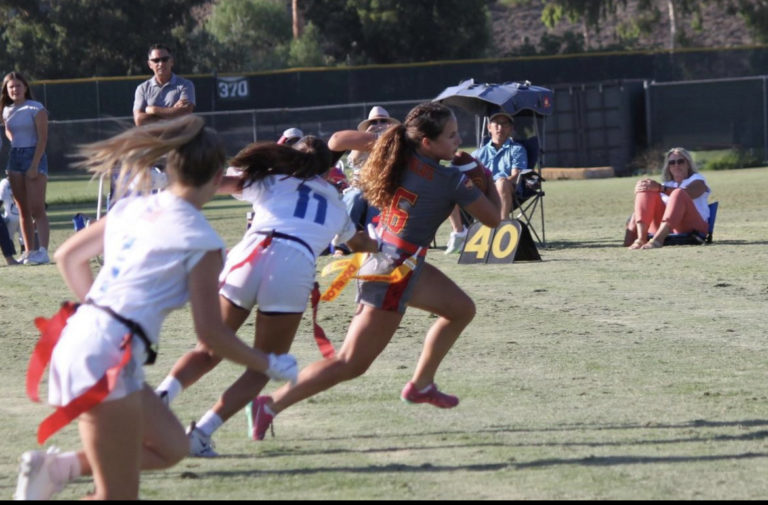
     Girls flag football is burning up the field with an aggressive determination to win, with both Varsity and JV representing our school and making Pablo proud. From an undersized club to a booming new sport, the girls flag football team has been welcomed into the inferno. 

     As a new CIF sport, the girls flag football team is dominating the competition with a score of 18-7 at the last varsity game against Aliso Niguel High School. They have currently played 7 league games with varying outcomes. The girls really have proved that with enough effort anything is possible. 

     With 15 girls on varsity and 13 on JV, the team has made bonds that are unbreakable. Leah Vanderveen, a freshman on JV, said it best when she stated, “The whole team is so nice and uplifting on and off the field. The girls that played last year are so welcoming to all of the new players.”

     The team considers team bonding very important. They regularly have lunch together and when the weather is nice they go swimming. During away games on the bus they blast music and have a good time. Through these fun activities they have grown together and have become more like a family than a team. 

     The team started playing as a club two years ago but this year is its official debut to being a certified school sport. In past years the team was small and had inconsistent practices a couple of times a week. Now, with a consistent practice schedule and two full teams, the team has done an incredible job growing and recruiting more members. 

     Katie Neilson was one of the first original players and has since become captain of the varsity team. She has watched this team grow since the start and has fought hard for it to become an official sport. Neilson stated in an interview, “It’s so nice to finally wear the Mission jersey after two years of flag football being a club.” Neilson also mentioned how much she loves her team and the sport she plays.

     Flag football has had an incredible impact on many of the girls on and off the field. Avin Mohammadi, a freshman on JV, states, “It’s all like we’re one big family.” So many girls use this sport as a home away from home. Flag football is a place where many of the girls are able to escape their life and get lost in running plays and scoring touchdowns. It’s incredible that it is  finally getting

 the recognition it deserves. Especially since people view it as “scary” or “aggressive”. 

     Yes, the sport can be aggressive, but as Geneva Bjornstad, a junior on JV, explains, “I wish people understood that girls flag football is much different than boys tackle football. So there are different rules and regulations.” And Vanderveen says, “I wish people understood that even though it has football in its name it is definitely not as aggressive as tackle football. And I think if more people knew this a lot more girls would be playing.”. They all state that flag football is not as scary as people make it sound and more girls would have a blast if they joined!

     Flag football has positively impacted all of their lives and even people before them. Vanderveen explained, “My mom inspired me to join because she played in high school! And she balled out!” People have so much to share about the impact and importance of flag football and how wonderful it is. If people would just listen or even do research maybe it wouldn’t be as scary as they think. 

     These girls are so incredibly dedicated to flag football and will continue to improve and grow together. They will continue to destroy their biggest rival Trabuco High School and win. The players have become like a second family to one another and they will continue burning up the football field today, tomorrow, and for many more years to come.