
Lunar New Year is a holiday celebrated in numerous cultures that marks the beginning of the lunar calendar. It is usually celebrated at the end of January and the beginning of February. The 2023 Lunar New Year starts on January 22nd and ends on February 1st, marking the beginning of the year of the rabbit and the Vietnamese year of the cat. It’s most commonly celebrated in Asian countries, including but not limited to China, South Korea, and Vietnam.
The Chinese New Year is celebrated for about 15 days with a series of festivals and street fairs. It is also known as the Spring Festival or Chūnjié. Each year corresponds with a different Chinese zodiac, and 2023 is the year of the rabbit. Firecrackers are very popular during the new year because they are believed to scare off evil spirits. Other popular celebrations are the festival of lanterns, dragon dances, lion dances, and family dinners. The dragon dance is performed by a group or team of dancers that move a giant puppet resembling a dragon. The lion dance is executed by dancers in lion costumes. The dances are performed to bring good luck and fortune in the new year.
The Korean New Year, also known as Seollal, is a time to honor ancestors and look forward to prosperity in the new year. Families will wear hanboks: traditional Korean dresses worn for special occasions. An important tradition is sebae, a deep traditional bow to pay respect to elders, usually performed by children. Another tradition during Seollal is Charye, which is a service that respects and worships ancestors.
The Vietnamese New Year celebrates the beginning of a new year and the welcoming of spring and is celebrated for about 5 to 7 days. It’s also known as Tết Nguyên Đán, or Tết for short. Tết is a family-centered holiday, usually celebrated with a feast to welcome relatives and exchange best wishes for the new year. People will make loud noises in the streets to get rid of evil spirits, using drums, firecrackers, bells, and gongs. Parades, festivals, and other events are also very popular.
Most traditions during Lunar New Year symbolize and celebrate prosperity, abundance, and togetherness. Some cultures clean their houses to get rid of unlucky spirits that gathered in the old year to make space for good will and good luck. Others participate in traditional rituals to honor their ancestors and elders. Common traditions during the Lunar New Year include festivals and parades, and the giving of red envelopes with money to symbolize good luck, good fortune, happiness, and abundance.
Lunar New Year 2023

Coach Brooke on her experience with volleyball

The game is neck and neck, and both teams are sweating, gasping for air. They’ve been playing for what feels like forever, and yet everyone on that court is still pushing through, and will do anything to make sure that ball does not drop, throwing their bodies across the court and even pushing their own teammates out of the way to prevent it.
The players on this court do not just have incredible strength and speed, but also an added sense of teamwork and good sportsmanship. They are not just well-rounded volleyball players, but also just well-rounded people, and while these qualities can be obtained through natural talent, the attributes usually originate from their equally talented coaches, our own girl’s volleyball team being coached by the brilliant Brooke Nicholson, a skillful woman that I had the pleasure of learning about.
From the young age of nine, Nicholson found herself drawn to the sport through her step sister. While she was going on her own high school volleyball journey, Nicholson would sit and watch as the teams practiced and played games, sometimes even walking from school to home games. From those moments spent enjoying watching her sister play volleyball, Nicholson developed a large passion for the sport, one that she continued throughout her life.
And from then on, she was rooted for success. During her sophomore year of high school here at Mission, Nicholson had made the varsity team which was a huge personal goal she had hoped to accomplish.
Making the varsity team was not the only achievement she was able to make during her high school career. While playing on the team, Nicholson and her teammates were able to become the first girls volleyball team at MVHS to make it into the CIF semifinals, an honor that even now Coach Brooke Nicholson looks back on as one of the proudest moments of her career.
Coach Nicholson did not just want to play the sport she loved, however; she also wished to inspire others to experience volleyball. After her incredible time playing for MVHS, she decided to turn a new leaf and became an assistant coach at 18 years old. At this point, Nicholson was also attending Concordia University, where she was majoring in Sports Medicine and Kinesiology.
From there, she found herself coaching girls volleyball for Mission, returning to her alma mater still doing the thing she loved when she was enrolled. Her time at Mission has been a memorable journey, one that brought multiple victories and shaped some of the greatest volleyball players Mission has ever seen.
Last year’s season was a particularly unforgettable yet bittersweet part of Nicholson’s career. She unfortunately had to say goodbye to ten seniors who she had been with during their entire high school experience, but was lucky enough to be able to make their last year memorable by helping them get to CIF, a victory which Nicholson labeled as one of her proudest moments while coaching for Mission.
However, that is not to say this year’s season wasn’t one for the books. To Nicholson, the freshmen that had recently joined the program showed great potential and positivity throughout their first season. “The best part of [this year] was knowing that we’re going to be strong in the next few years to come.”
Throughout her years of playing and coaching, Nicholson learned many valuable tips that she now applies to her players. One of the most important pieces of advice to her when it comes to volleyball is to learn how to embrace uncomfortableness. “[Volleyball] is a hard sport at the beginning, but it’s really rewarding once it clicks.”
While on and off the court, Nicholson encourages her young players to be strong, independent, and admirable women, something that she hopes they take away from the sport along with the importance of character building, working with others, and motivation. “It’s all these things that are a part of being an adult that you can learn from a fun sport.”
It is clear that Nicholson’s passion for volleyball and the effort she puts into it is something that is a part of who she is, or in her own words an “obsession/identity”. No matter how you phrase it, the change she inflicts onto the program is one that alters the program for the better, and her legacy will hopefully be passed down for generations to come.
Largest Strike in American Higher Education History Ends
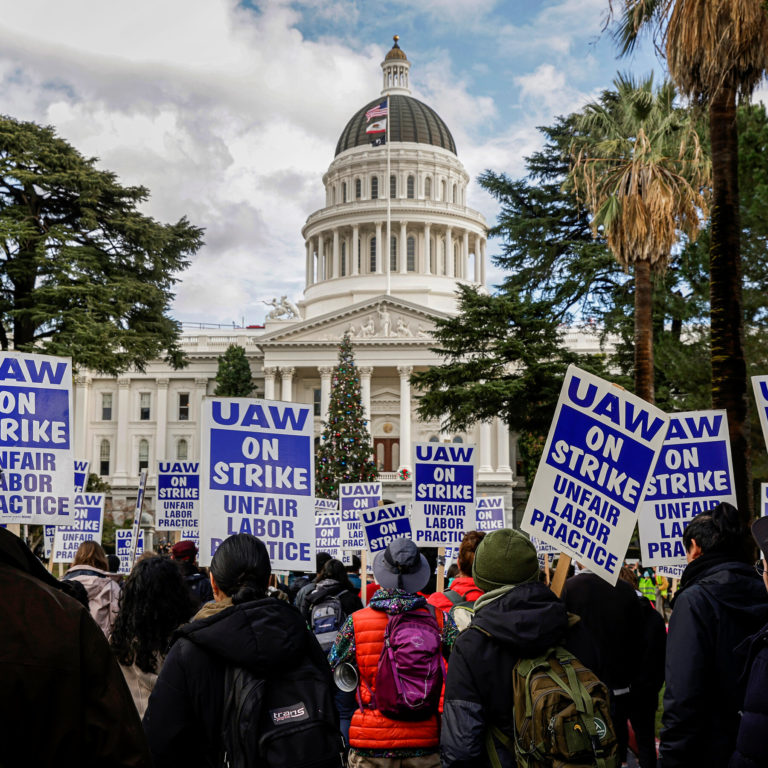
Since November, 48,000 workers, including graduate-student teachers, teaching assistants, and researchers united under the United Automobile Workers (UAW), have quit their teaching jobs and gone on strike to demand higher wages to pay for the expensive living cost of California, resulting in the largest and most significant strike in the history of American higher education thus far.
Lectures, on-going research, and grading were disrupted across the campuses, due to the lack of the teaching staff being present. This shows the real impact of the teaching employees on the university; without teaching assistants or instructors, there would be no operating UC.
According to Student Researchers United, “We teach the classes, grade the papers, and perform the cutting edge research that has earned UC its reputation as the best public university in the world … In short, UC works because we do,” they stated as the fight for better work policies and pay continues.
With their current pay and the rising costs of housing in expensive cities, the workers have been stating that they are on the verge of going into debt. In addition to higher pay, the teaching staff has been demanding better working conditions such as assistance with paying for expensive housing, transportation, child care, etc.
As for the ratification of the 3-year contract for improved work conditions and higher wages, the vote between student-teaching employees was 11,386 to 7,097 while the vote between graduate researchers was 10,057 to 4,640.
The 40-day strike ended on December 23, 2022 as representatives of UAW signed two contracts that would raise the wages of the workers, promising to improve the cost of living in California. The agreement approved by the university administrators stated that throughout a two-and-a-half year contract, teaching assistants would receive a raised salary from about $23,000 to $34,000 and that graduate student researchers would get a raised salary from $22,000 to $35,000.
Along with higher pay, teaching employees will receive better transportation and health care as well as improved family leave and child care. Workers can also be guaranteed a higher level of job security to increase their chances of keeping their job and better work conditions to protect against harassment and discrimination.
A Man Called Otto: a story of loss and life

Recently, there has been a plethora of heart-wrenching, tear-inducing movies that have been created; most modern ones featuring either the most dramatic sequences you will ever see or, for some reason, a dog. While many may be disappointed to hear that Otto is not a dog, but in fact a grumpy, old man, this movie is still a story that will leave you with tears in your eyes, a new perspective on life, and will be a pleasure to watch.
When Otto is first introduced, he is irritated at imperfection, a trait that many might believe to be the cause of his grouchy attitude. While his annoyance may only be a piece of the equation, the main reason for his joyous demeanor is due to the loss of his wife Sonya, a woman who was a huge part of Otto’s daily affairs.
Without Sonya, Otto loses his love for life, causing him to spiral into a depression, with the man going as far as attempting to end his life to be reunited with Sonya once again. On these occasions, the audience gets a glimpse into the love story of Sonya and Otto, and gets more context as to why Otto acts the way he does. The context of the scenes in pair with Tom Hanks’ acting abilities made the viewer able to sympathize and connect with his character on a deeper level.
Along with the flashbacks, moments in which Otto interacts with his others around him can be further juxtaposed with the past events to make the experience memorable. While his wife and unborn child both unfortunately passed, Otto is able to relive those certain memories through those around him; like how Marisole, his pregnant neighbor,is much like Sonya and his wish to experience fatherhood is granted through moments with Marisole’s children and Malcolm, a former student of Sonya’s.
Before the release of A Man Called Otto, the original New York Times bestselling book received a previous Swedish and Perisian adaptation by its original name A Man Called Ove in 2015. This adaptation was enjoyed by many, receiving a Rotten Tomatoes score of 91%, unlike A Man Called Otto which only received a score of 69%,
While A Man Called Otto may not be revolutionary or change the film industry as we know it, the film is still undeniably an enjoyable movie. Tom Hanks’ performance was well done, and displayed his character in a way that was true to his nature.
Even though the movie was moving, at some points it felt forced. It was in some moments even cheesy, like the use of ballads during somber scenes and slow-motioned shots. For a story as interesting as this and such a great cast, it would have made the experience more enjoyable if there were more unique choices in how they portrayed it.
If there’s one thing we can learn from Otto’s life, it’s that there is always something to live for, even if it is just a kind family next door. A Man Called Otto is a story of how life works in ways that are unexpected, and how kindness is an ever-giving entity that appears in unanticipated situations.
Millionaire Youtuber Mr Beast Accidentally Sparks Political Debate

In the small chance you don’t know him, Jimmy ‘Mr Beast’ Donaldson is one of the largest YouTubers on the platform, amassing his following from his creative philanthropic, borderline gameshow, videos (ex. Squid Game for a half million dollars, last to stay in the circle wins $100,000, hiding a briefcase on a private island and the first to find it gets the island, getting hunted by a bounty hunter etc.).
Donaldson recently released a video by the name of “1,000 blind people see for the first time;” nothing controversial happened in the video, he gave 1,000 people a $3,500 surgery that helps with vision loss. However, the name of the video rubbed some people the wrong way, and I can see why. Nearly all of Donaldson’s other videos don’t suffer from this fate but, for some reason, this one just discomforted me right when I started watching it.
Maybe it was the misleading title including “for the first time,” when cataracts are a condition that usually develop at age 40, according to the National Eye Institute, with it being extremely rare that babies are born with cataracts.
Maybe it was the fact that the video was sensationalized (although he usually uses this style and it never bothers me), but either way I don’t think Donaldson did anything wrong; he cured 1,000 people’s cataracts, and maybe he clickbaited a bit but he did cure their blindness as he promised.
However, this clickbait could possibly misinform Donaldson’s young audience into thinking he actually did cure blindness, which takes the world’s eyes away from a health issue that still direly needs research funding.
I think the main thing that discomforts me, though, is the near dystopian concept that this video has. Tens of thousands of people likely signed up to get cataracts done to them and a multimillionaire randomly chooses them in a raffle for them to get the surgery, to be able to work and live their life.
Every single word in that statement just feels wrong. But, once again, this is not a problem with Donaldson’s philanthropy, it’s a problem with our healthcare system.
In our current system we leave many stuck in poverty due to their eye loss at the bottom due to the massive $3,500 paywall that prevents them from even thinking about it. Even though the returns would be well over tenfold times, if they can’t afford it, they can’t afford it.
Donaldson thought the same after responding to the discourse made from his video: “I don’t understand why curable blindness is a thing. Why don’t governments step in and help?” And I think this is a very reasonable inquiry from Donaldson, they would likely get a major ROI if they cured their blindness as it would put them back in the workplace. The only reason I can think of is that governments are trying to stay as far away as possible from communism.
Whatever reason it may be that they don’t, I think this video was, in the end, a positive. For universal healthcare advocates, it sparks debate and inquiry about why we don’t and, through the dystopian nature of Donaldson’s video, highlights just how wrong our modern healthcare system has become.
Is Valentines day too dark for all the sweetness?

Valentine’s Day is said to be the sweetest and the most romantic day of the year, but history says otherwise. While people these days are celebrating the day of romance, the Romans may have celebrated a bloody and ¨jumbled day¨.
From around February 13-15, the Romans celebrated the feast of ¨Lupercalia¨(which was a festival/feast to purify the city). On this day the men supposedly sacrificed a goat and a dog, and then they would whip and slash the women with parts of the animals they had just killed. It was also said that ¨Young women would line up for the men to hit them because they thought it would make them fertile.¨ It was true that Valentine’s Day doesn’t only get jumbled, but also bloody.
Not only did all the craziness of the Lupercalia festival happen on that day when the Romans lived, but young men would also draw the names of women out of jars, and they would be ¨coupled up¨ for the duration of the Lupercalia or longer if the match was right.
The ancient Romans were also responsible for the name of our modern-day love. Emperor Claudius II executed two people on February 14 who were both named Valentine. Other stories suggest that one of the Valentines may have been killed for attempting to help Christians escape harsh Roman prisons, where they were often beaten and tortured. What a coincidence! Pope Gelasuis wanted to put off the Lupercalia, which was a great idea. But the festival was more of a conceptual interpretation of what it had once been. Noel Lenski, now a religious studies professor at Yale University, told NPR in 2011.”It was a little more of a drunken revel, but the Christians put clothes back on it. That didn’t stop it from being a day of fertility and love.”
Around the same time as the Lupercalia festival, the Normans celebrated what was called ¨Galatin’s Day¨. Gallatin was meant to be a ¨Lover of women¨. As the years went on, the holiday grew sweeter just like it is now.
Now, Cupid is often portrayed on Valentine’s Day as a naked baby launching arrows of love at unsuspecting lovers. But the Roman God, Cupid, has his roots in Greek mythology as the Greek god of love, Eros. Eros eventually did turn into the naked baby that launches arrows of love at unsuspecting lovers during these days!
Today this holiday is celebrated worldwide and very big in business! However, the day is a spoiled day for many. The celebration of Valentine’s goes on and it can be a holiday for getting flowers, and chocolate, and spending the day with your loved ones. But it can also be celebrated as a SAD (Single Awareness Day) by others.
Starting the Seasons With a Kick
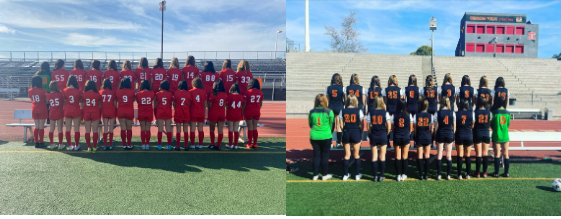
Soccer is a known sport around the world with millions of fans from many countries. It is a team sport that requires communication skills and hard work.
Our school has two girls’ soccer teams, JV and Varsity. Both teams have put so much effort and hard work into this season. We are about halfway through the season, and many improvements have been made throughout the season.
I, myself, am on the JV soccer team and get to experience the team firsthand. To be successful as a team, all players on the team need to be comfortable with each other and be able to communicate on the field properly.
One thing that helps with the chemistry on the field is working on the chemistry off of the field. As a team, we all get together before home games or once a week and have pasta dinners to get to know each other. It truly helps us come together as a team which helps us come together on the field and, ultimately, become successful during our games.
We also connect by participating in a secret sister gift exchange every away game or once a week. It is almost like a Secret Santa gift exchange but throughout the season. Each girl would draw a name along with what the person likes and whose name they pick, which is who they buy a small gift for every week. Participating in this allows the girls to get to know each other and to participate in something fun and surprising.
This season both teams have played eight games against Dana Hills, Trabuco Hills, and El Toro. The varsity team has won four and tied five, and the JV team has lost five, tied three, and won one. The season has officially ended and varsity did make it to CIF, but unfortunately lost to Rancho Cucamonga in penalty kicks.
Everything that has happened this season is because of the hard work and dedication our team has put on the field. We are so incredibly proud of these teams and are incredibly sad to say goodbye to our seniors, but there is definitely bright future ahead of us. I know that our soccer team will be undeniably successful in the upcoming years, just as they were this season.
Strike that, repair it: Nurses formed picket lines in front of major NYC hospitals—and they deserved to be heard!
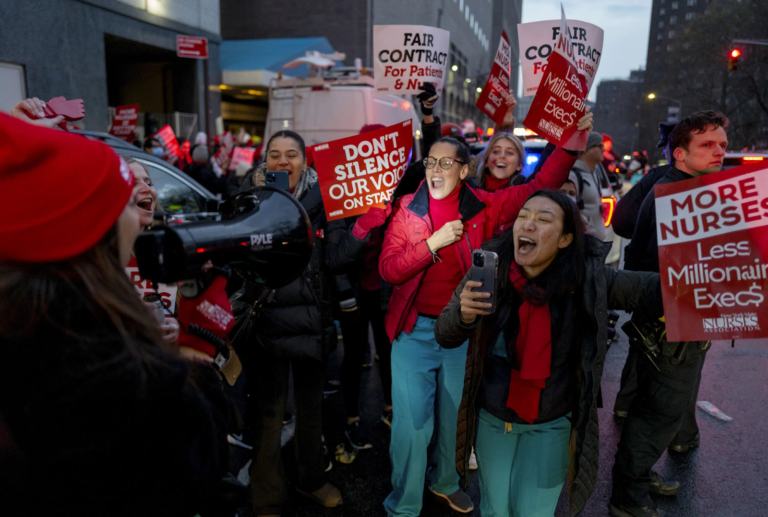
“On strike for better patient care,” “More nurses, less millionaire execs!”, “Fair contract for patients and nurses!”, read the signs at the picket lines in front of two major NYC medical facilities.
NYC Nurses Begin Three-Day Strike
January 9th marks the first day of a major labor strike in New York City. More than 7,000 nurses from Mount Sinai Hospital and the Montefiore Medical Center walked out to protest the unfair conditions that they have been working with, especially in recent years.
The main concern behind the movement seems to be the understaffing of the hospitals. According to The Washington Post, “Nurses at Mount Sinai Hospital in Manhattan and Montefiore Medical Center in the Bronx say they want management to increase hiring to relieve on-the-job stress and agree to pay penalties to nurses who work understaffed shifts.”
Especially after the coronavirus pandemic, nurses are having to work very long and very busy shifts. In an interview with CNN, Montefiore nurse Naniaka Camara says “she’s often late providing medication or other services that patients need due to staffing shortages that can stretch her shifts to 12 or 14 hours.”
In terms of what the nurses’ goals were for the strike, the president of the American Nurses Association Jennifer Mensik Kennedy explained in an interview with NPR, “The American Nurses Association shares the nurses’ frustration with a lack of solutions. And we’ve really worked together with decision-makers in organizations and nationally to say, you know, we really do need to work through and address safe staffing issues. We need to look at how we can address getting more nurses to be faculty and address the faculty shortage. And we also need to look at the work environment and encourage nurses to stay nurses and not to leave the profession. And we want nurses to be nurses for their entire career. So those are the three areas I think we could really focus in on in order to make a sustainable change.”
As of January 11th, negotiations with the hospitals have ended and the nurses have returned to work. The negotiations included a deal to increase pay and the opening of many more nursing positions. Nurse-patient ratios were also introduced to make the nurses’ workload more manageable. Tentative contracts were drawn and the nurses and unions will vote soon.
Labor Strikes and Their Purpose
Labor strikes have been occurring in this country ever since the Industrial Revolution. Terrible working conditions for factory workers in the first years of mass manufacturing were extremely common. Because of this, workers began to come together and form what were some of the first labor unions in the United States. Large groups of workers would assemble protests, or strikes, demanding things like higher wages, shorter hours, safer working conditions, and more.
So, the purpose of a strike is ultimately to demand a better working situation for laborers or to protest against employers for unfair conditions.
There is a lot of planning that goes into organizing a labor strike. It involves contacting union members, reading bargaining agreements to see if a strike would be legal, collecting funds for picketers, and trying to convince the public that it is a worthy cause.
That is why it is a really big deal when a major strike occurs, especially with a count of more than 7,000 people as in the recent NYC nurse strike.
There is, as with many things, controversy surrounding labor strikes. In terms of the NYC nurse strike, some are asking, “Why are the nurses abandoning their patients for this?” Actually, the patients in both hospitals were taken care of by a supply of temporary workers who filled the roles of the nurses who were out picketing. They prepared well in advance to ensure that the patients were covered and everything would be safe.
A lot of the opposition to labor strikes and unions comes from people with a pro-business ideology. The business or employer to whom the strike is directed finds them disruptive. In a business setting, a strike can seriously decrease the daily profit due to the formation of picket lines in front of and around the building. As for the hospitals, they had trouble staying organized and were, of course, in opposition to the strike and the disruption that it caused.
How to Show Support
There are many ways to show support for workers on strike. According to a TeenVogue article by Jacqui Germain, some supportive actions include: publicly supporting the strike, visiting the picket line to help in any way, sharing information about the strike with friends, and pushing politicians and leaders to show their support for the workers as well.
I strongly believe that people should never cross a picket line, even though, of course, it is entirely up to each individual. Crossing the picket line is considered very disrespectful and even demeaning to those who are participating in the strike. Going on strike is a big deal- so if a group of workers decides that there is an issue important enough to form a picket line over it, their voices should be respected, even if you do not agree with what they are saying.
Our workers, especially our nurses, keep the world going around. They were heroes of the coronavirus pandemic. They continue to save lives every day. Their voices deserve to be heard. Don’t you think it’s the least we could do?
I guess a coherent plot wasn’t on The Menu
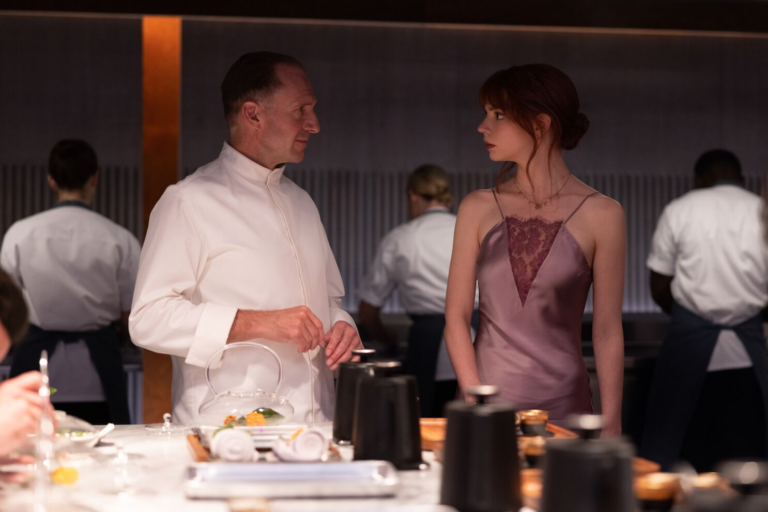
The Menu had potential. With a star-studded cast, the film received a 7.3/10 from IMDb and an 89% score from Rotten Tomatoes (the audience score was 76%). Main actors Ralph Fiennes, who plays an extremely obsessive celebrity chef, and Anya Taylor-Joy who plays a guest unused to the luxury dining lifestyle both received Golden Globe nominations for Best Actor and Actress.
The movie was generally very well-received, and yet I cannot seem to understand why. If I had to personally provide it a score, I would give it a 4/10.
Directed by Mark Mylod, The Menu focused on the experience of two young people going to dine in one of the most exclusive, world-renowned restaurants located on a secluded private island. With a cast of eccentric and uniquely troubled characters joining in on the dining experience as well, the night progresses only to reveal that there is something deeply amiss.
The menu started as any other luxury menu would: drinks, an amuse-bouche, and a plethora of accompanying courses. With the presentation of each course, their meals become less and less luxurious. Secrets, blood, gore, and the guests’ utter hopelessness is what comes next in the sequence of events.
In between the chaos of trying to figure out what was going on, we get to hear Chef Julian Slowik’s story: and yet nothing about why he is now a homicidal maniac. He has a background in working at a fast-food burger restaurant, and it is implied that he worked his way up to be the profound chef he is today. He confronts the night’s guests by telling how each of them, in some way or another, contributed to him losing his passion for cooking and exploiting workers quite like himself. Which is great, but it doesn’t explain anything as to why the gory events occurred.
Sure, the film had plenty to say about the divisions between class and obsession and of course, the whole art-versus-the-artist debate. And yet, it wasn’t presented as a philosophical commentary: it was a thriller, trying desperately to be an astute take on the problems in modern society, specifically those leading a luxurious life. While these are all very important topics that our society needs to learn about, I was definitely not expecting them to appear in the thriller movie that I was eager to see.
The whole movie felt as if it could not decide whether the message or the thrill was more important: leading to a rough combination that most certainly did not mix well.
And then there was the ending. It was an incredibly unsophisticated ending for a seemingly sophisticated film, and it initially made me wonder if they wrote it in for a comedic factor. I ultimately decided that even if it was, it greatly missed the mark. The movie lacked so much closure, I felt that the whole point was wasted. As if the writers thought a movie about the problems with class divisions and the respect of artisans would not be appealing to the public, so they threw in a couple of intense, bloody scenes at the last minute and crossed their fingers that their message would get across.
After I first viewed the trailer, I went into the theater expecting an edge-of-your-seat, spill-your-popcorn-everywhere, punch-the-person-in-the-seat-to-your-left kind of movie. I was expecting a thriller, teetering on the edge of horror, maybe even with some cannibalism sprinkled in here and there. I never thought I would say it, but by the end of the movie, I found myself wishing that cannibalism was involved.
I only wish each scene in The Menu was as carefully crafted as each of Chef Slowik’s courses. As I said, the movie had great potential, but the plot was too choppy and barely even coherent. It had a lot to say, but did not know how to properly say it, leaving me wanting both more and less at the same time. Which is why The Menu left me hungry.